
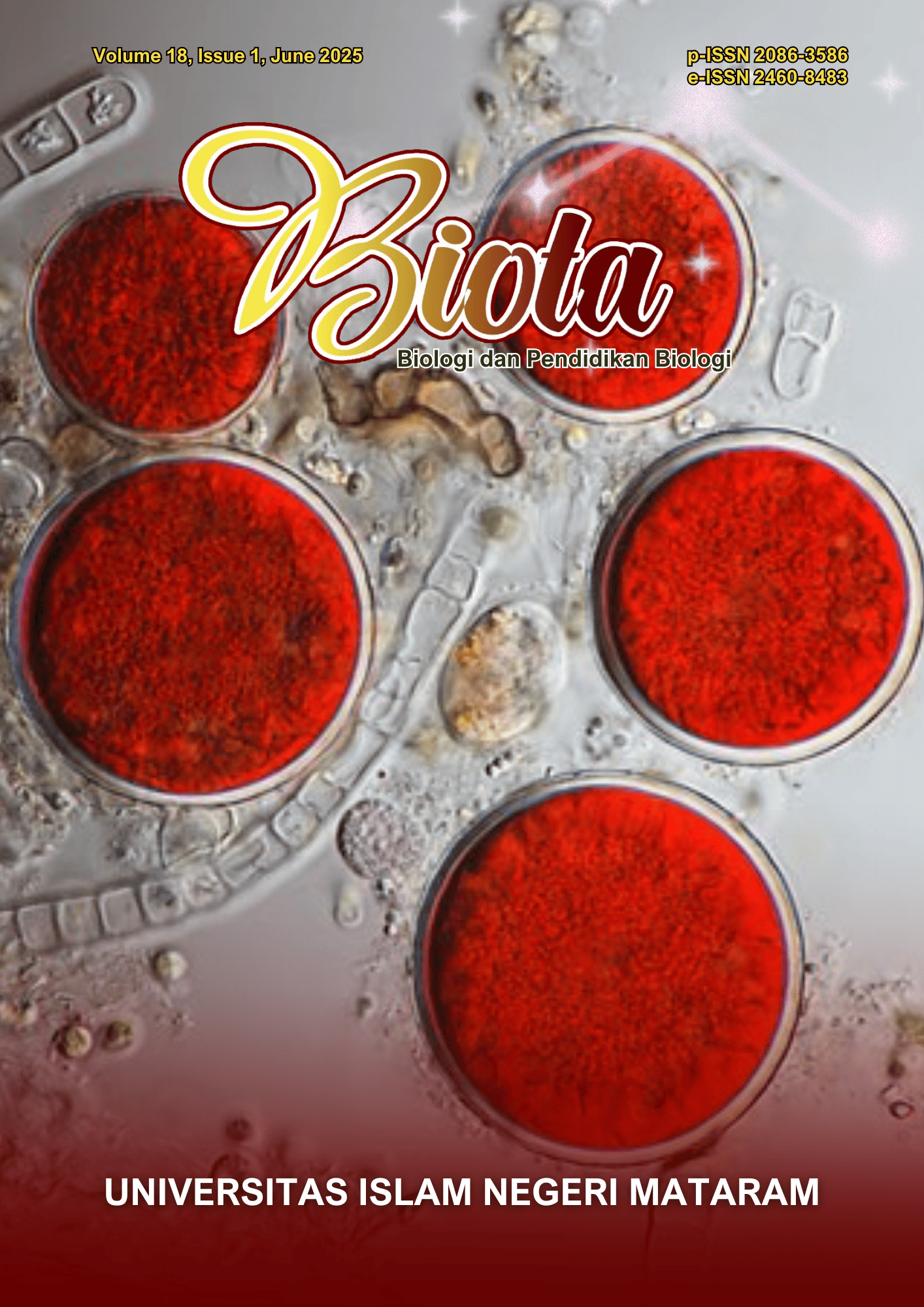
The Efficacy of Haematococcus pluvialis Culture as a Bioremediator for Tofu Effluent
Article Sidebar
Main Article Content
Abstract
Wastewater management is one of the issues at the heart of the Sustainable Development Goals. This is urgent because waste that is not properly managed can cause damage to water bodies, reducing clean water sources that can be used for household, office and industrial needs. One of the low-cost yet effective wastewater management strategies which also produce valuable products is the use of microalgae as remediators to improve the quality of polluted waters. The aim of this study was to evaluate the efficiency of H. pluvialis culture as a bioremediator for tofu effluent. The research stages consisted of activation of H. pluvialis microalgal starter in Walne medium, followed by cultivation of microalgae in tofu effluent medium, observation of microalgal growth in the effluent, and measurement of water quality parameters such as pH, colour, BOD and COD, as well as the aroma of tofu effluent before and after use as a microalgal growth medium. According to the growth curve of H. pluvialis in the tofu wastewater medium, it is known that this microalgae can grow well in the effluent and can improve wastewater quality. Where the pungent odour typical of soya waste began to disappear from the second day of cultivation, the pH increased from acidic to neutral, and BOD and COD levels were drastically reduced. In conclusion, H. pluvialis microalgae can be used as a bioremidiator of tofu ffluent as it can effectively improve the quality of the wastewater.
Article Details

This work is licensed under a Creative Commons Attribution-ShareAlike 4.0 International License.
References
Ajijah, N., Tjandra, B. C., Hamidah, U., Widyarani, & Sintawardani, N. (2020). Utilization of tofu wastewater as a cultivation medium for Chlorella vulgaris and Arthrospira platensis. IOP Conference Series: Earth and Environmental Science, 483(1). https://doi.org/10.1088/1755-1315/483/1/012027
Andersen, R. A. (2005). Algal Culturing Techniques. Elsevier Academic Press.
Aziz, M., Darmawan, A., & Juangsa, F. B. (2021). Hydrogen production from biomasses and wastes: A technological review. In International Journal of Hydrogen Energy (Vol. 46, Issue 68). https://doi.org/10.1016/j.ijhydene.2021.07.189
Collivignarelli, M. C., Baldi, M., Abbà, A., Caccamo, F. M., Miino, M. C., Rada, E. C., & Torretta, V. (2020). Foams in wastewater treatment plants: From causes to control methods. In Applied Sciences (Switzerland) (Vol. 10, Issue 8). https://doi.org/10.3390/APP10082716
Delgadillo-Mirquez, L., Lopes, F., Taidi, B., & Pareau, D. (2016). Nitrogen and phosphate removal from wastewater with a mixed microalgae and bacteria culture. Biotechnology Reports, 11. https://doi.org/10.1016/j.btre.2016.04.003
Gerardi, M. H. (2006). Wastewater Bacteria. Wiley. https://books.google.co.id/books?id=LQjSLnQJHKwC
Liu, J., Yin, J., Ge, Y., Han, H., Liu, M., & Gao, F. (2021). Improved lipid productivity of Scenedesmus obliquus with high nutrient removal efficiency by mixotrophic cultivation in actual municipal wastewater. Chemosphere, 285. https://doi.org/10.1016/j.chemosphere.2021.131475
Mohsenpour, S. F., Hennige, S., Willoughby, N., Adeloye, A., & Gutierrez, T. (2021). Integrating micro-algae into wastewater treatment: A review. In Science of the Total Environment (Vol. 752). https://doi.org/10.1016/j.scitotenv.2020.142168
Musa, M., Arsad, S., Sari, L. A., Lusiana, E. D., Kasitowati, R. D., Yulinda, E. N., Nadhira, T., & Cahyani, D. (2021). Does Tofu Wastewater Conversions Nutrient Increase the Content of the Chlorella pyrenoidosa? Journal of Ecological Engineering, 22(2). https://doi.org/10.12911/22998993/130886
Putri, D. S., & Alaa, S. (2019). The Growth Comparison of Haematococcus Pluvialis in Two Different Medium. Biota. https://doi.org/10.20414/jb.v12i2.202
Ren, B., Zhao, Y., Lyczko, N., & Nzihou, A. (2019). Current Status and Outlook of Odor Removal Technologies in Wastewater Treatment Plant. In Waste and Biomass Valorization (Vol. 10, Issue 6). https://doi.org/10.1007/s12649-018-0384-9
Shah, M. M. R., Liang, Y., Cheng, J. J., & Daroch, M. (2016). Astaxanthin-producing green microalga Haematococcus pluvialis: From single cell to high value commercial products. In Frontiers in Plant Science. https://doi.org/10.3389/fpls.2016.00531
Sintawardani, N., Hamidah, U., Widyarani, Wulan, D. R., & Nilawati, D. (2022). Recovery of Energy and Materials From Small-Scale Tofu Processing Industries in Indonesia. https://doi.org/10.4018/978-1-7998-9664-7.ch013
Sjafruddin, R., Agustang, A., & Pertiwi, N. (2022). ESTIMASI LIMBAH INDUSTRI TAHU DAN KAJIAN PENERAPAN SISTEM PRODUKSI BERSIH. Jurnal Ilmiah Mandala Education, 8(2). https://doi.org/10.36312/jime.v8i2.2826
Wei, H., Yu, H., Zhang, G., Pan, H., Lv, C., & Meng, F. (2018). Revealing the correlations between heavy metals and water quality, with insight into the potential factors and variations through canonical correlation analysis in an upstream tributary. Ecological Indicators, 90. https://doi.org/10.1016/j.ecolind.2018.03.037